

H.E. Arthur Foulkes presented the keynote address at the opening ceremonies for the McHari Institute... Read more
Commonwealth of the Bahamas
Sovereign: Queen Elizabeth II (1952)
Governor-General: Arthur Foulkes (2010)
Prime Minister: Hubert Ingraham (2007)
Land area: 3,888 sq mi (10,070 sq km); total area: 5,382 sq mi (13,940 sq km)
Population (2008 est.): 307,451 (growth rate: 0.5%); birth rate: 17.0/1000; infant mortality rate: 23.6/1000; life expectancy: 65.7; density per sq km: 30
Capital and largest city (2003 est.) : Nassau, 222,200
Monetary unit: Bahamian dollar
Languages : English (official), Creole (among Haitian immigrants)
Ethnicity/race : black 85%, white 12%, Asian and Hispanic 3%
Religions : Baptist 35%, Anglican 15%, Roman Catholic 14%, Pentecostal 8%, Church of God 5%, Methodist 4%, other Christian 15% (2000)
National Holiday : Independence Day, July 10
Literacy rate: 98.2% (1995 est.)
Economic summary: GDP/PPP (2005 est.): $5.696 billion; per capita $18,900. Real growth rate: 3%. Inflation: 1.2%. Unemployment: 10.2%. Arable land: 0.58%. Agriculture: citrus, vegetables; poultry. Labor force: 176,300 (2004); agriculture 5%, industry 5%, tourism 50%, other services 40% (2005 est.). Industries: tourism, banking, cement, oil transshipment, salt, rum, aragonite, pharmaceuticals, spiral-welded steel pipe. Natural resources: salt, aragonite, timber, arable land. Exports: $469.3 million (2004 est.): mineral products and salt, animal products, rum, chemicals, fruit and vegetables. Imports: $1.82 billion (2004 est.): machinery and transport equipment, manufactures, chemicals, mineral fuels; food and live animals. Major trading partners: U.S., Poland, Spain, Germany, France, South Korea, Brazil, Japan, Italy, Venezuela (2004).
Member of Commonwealth of Nations
Communications: Telephones: main lines in use: 139,900 (2004); mobile cellular: 186,000 (2004). Radio broadcast stations: AM 3, FM 5, shortwave 0 (2006). Television broadcast stations: 2 (2006). Internet hosts: 359 (2005). Internet users: 93,000 (2005).
Transportation: Railways: 0 km. Highways: total: 2,693 km; paved: 1,546 km; unpaved: 1,147 km (1999). Ports and harbors: Freeport, Nassau, South Riding Point. Airports: 64 (2005).
International disputes: disagrees with the US on the alignment of the maritime boundary; continues to monitor and interdict Haitian refugees fleeing economic privation and political instability .
The Hon. Frederick A. Mitchell, MP Minister of Foreign Affairs
The Hon. Glenys Hanna-Martin, MP Minister of Education, Technical & Vocational Training
The Hon. Myles LaRoda, MP Minister of Social Services, Information & Broadcasting
The Hon. Alfred Sears, MP Minister of Immigration & National Insurance
The Hon. John Pinder, MP Attorney General & Minister of Legal Affairs
The Hon. Sen. Michael Halkitis Minister of Economic Affairs
The Hon. Dr. Michael Darville, MP Minister of Health & Wellness
The Hon. Clay Sweeting, MP Minister of Works & Family Island Affairs
The Hon. Keith Bell, MP Minister of Housing & Urban Renewal
The Hon. Wayne R. Munroe, MP Minister of National Security
The Hon. Mario Bowleg, MP Minister of Youth, Sports & Culture
The Hon. Vaughn Miller, MP Minister for the Environment and Natural Resources *(Note: passed away Sept 2025) *
The Hon. JoBeth Coleby-Davis, MP Minister of Energy & Transport
The Hon. Jomo Campbell, MP Minister of Agriculture & Marine Resources
The Hon. Pia Glover-Rolle, MP Minister of Labour & the Public Service
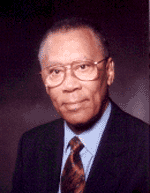
Governor General
Sir Arthur Foulkes
Brief History of the Bahamas
The Arawak Indians were the first inhabitants of the Bahamas. Columbus's first encounter with the New World was on Oct. 12, 1492, when he landed on the Bahamian island of San Salvador. The British first built settlements on the islands in the 17th century. In the early 18th century, the Bahamas were a favorite pirate haunt.
The Bahamas were a Crown colony from 1717 until they were granted internal self-government in 1964. The islands moved toward greater autonomy in 1968 after the overwhelming victory in general elections of the Progressive Liberal Party, led by Prime Minister Lynden O. Pindling, over the predominantly white United Bahamians Party. With its new mandate from the black population (85% of Bahamians), Pindling's government negotiated a new constitution with Britain under which the colony became the Commonwealth of the Bahama Islands in 1969. On July 10, 1973, the Bahamas became an independent nation.
A chronology of key events:
1492 Christopher Columbus makes his first landing in the New World in the Bahamas.
1647 English and Bermudan religious refugees, the Eleutheran Adventurers, establish the first European settlement on the Bahamas.
1666 - Colonisation of New Providence Island begins.
1717 - Bahamas become a British crown colony.
1783 - Spain cedes the Bahamas to Britain in accordance with the Treaty of Paris.
1834 - Emancipation of slaves.
1940-45 - The Duke of Windsor, formerly King Edward VIII, serves as governor.
1950 - Britain grants the US a military test range and tracking station for guided missiles in the Bahamas.
1955 - Free trade area established in the town of Freeport.
1964 - Bahamas granted internal autonomy.
1967 - Lynden Pindling becomes prime minister after his centrist Progressive Liberal Party (PLP) wins the islands' first legislative elections.
1972 - Negotiations with Britain over independence begin in the wake of an overwhelming victory in the elections by the PLP, which campaigns on a platform of independence.
Independence
1973 - The Bahamas become independent.
1983 - Government ministers face allegations of drug trafficking.
1984 - Pindling is endorsed as PLP leader after denying charges of corruption and ties to drug traffickers.
1992 - Hubert Ingraham becomes prime minister after his centre-left Free National Movement (FNM) wins an absolute majority in the general elections, ending 25 years of rule by Pindling.
1996 - Ingraham reinstates the death penalty for murder.
1997 - Ingraham returns as prime minister after his party is re-elected.
1998 - Two convicted murderers are hanged despite international opposition and concern over the use of the death penalty in the Caribbean.
2000 August - "Father of independence" Sir Lynden Pindling dies. He was head of government from 1967-92.
2001 November - Dame Ivy Dumont becomes the Bahamas' first woman governor-general.
2002 May - Veteran politician Perry Christie leads his Progressive Liberal Party to a landslide victory, unseating the Free National Movement, which has been in power for 10 years.
2004 September - Hurricane Frances sweeps through, causing widespread damage. Weeks later Hurricane Jeanne batters the Bahamas.
2006 March - UK-based final appeals court rules that the mandatory death sentence for murder breaches the Bahamian constitution. It was last used in 2000.
2007 May - Former Prime Minister Hubert Ingraham's Free National Movement wins parliamentary elections.
Dr. Kevin Alcena

